


1990. As global tensions start to ease and positive change begins in some arenas of world conflict, new areas of tension arise. Mikhail Gorbachev is awarded the Nobel Peace Prize for his actions in easing the Cold War, the demolition of Berlin Wall begins, and in South Africa, Nelson Mandela is released from prison. But Saddam Hussein invades Kuwait; US President George Bush responds with Operation Desert Shield™.
In lighter news, The Simpsons airs for the first time. Paleontologist Sue Hendrickson discovers a 90% complete skeleton of a T-Rex in South Dakota, later named “Sue,” after her. The Hubble Space Telescope is placed in orbit. And some guy named Tim Berners-Lee proposes a vast system of sharing of information, which he calls the World Wide Web.
In retrospect, 1990 seems to have been a relatively slow year in music, as if the whole musical world were holding its breath in anticipation of the alt-rock revolution that would take over the airwaves the following year. But that’s partly a distortion of hindsight, isn’t it? When I was living it, the year seemed pretty darned good. There was plenty of great music to discover.
My Top 6 Albums of 1990
As always, you can jump to the playlist at the bottom of each post to listen while you read.
Within each tier (Top 6, Next 6, etc.), all albums are listed roughly chronologically (all release dates from Wikipedia, unless otherwise noted).
 The KLF
Chill Out
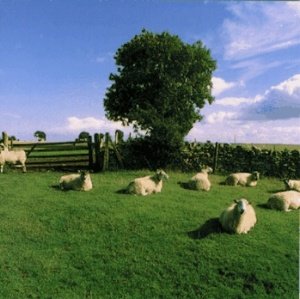 The KLF
Released 1990/02/05
I had never heard of the KLF before embarking on the retrospective listening project that has since become this website. My first exposure to them was their 1991 album The White Room, which comes across to me as not much more than a big, dumb, dance-party album—and not a particularly good one at that.
But Chill Out is something else entirely. It makes no attempts at dance-ability, no grasps at coolness or bravado, no chants of “This is what KLF is all about!” as if simply repeating the declaration were enough to fill the hearts of all listeners with joy.
Instead, Chill Out is a blissed-out, very chill, ambient, trance-inducing travelogue, which chronicles an imaginary late-night road trip from Texas to Louisiana. The music is carried by extraneous sounds—of crickets, running water, the passing of cars and trucks. Trains rush by, blaring horns and triggering crossing signal bells. And there’s radio. Lots of radio. It drifts in and out of consciousness as in a dream. (I don’t recommend playing this for any late-night driving, by the way.)
Yes, it’s all a bit ridiculous—God only knows what all those shepherds and their flocks are doing in East Texas, not to mention a gathering of Tuvan throat singers. (Maybe they picked them up on KTRU Rice University Radio on their way out of Houston.) In fact, the entire concept is pure fiction—the band members had never even been to the region to make the same trip.
But it doesn’t matter. The music transports you nonetheless. Based on my low estimation of The White Room, I almost didn’t bother to check out Chill Out at all. But I’m glad I did.
Playlist Note: I was not able to find this album on Spotify. Of my three selections—“Madrugada Eterna,” “Dream Time in Lake Jackson,” “Wichita Lineman Was a Song I Once Heard” —I was only able to find one song, but in an inferior club mix which completely loses the trance-y charm of the album version. Fans of ambient and electronic music should definitely check this out.
Sinéad O’Connor
I Do Not Want What I Haven’t Got
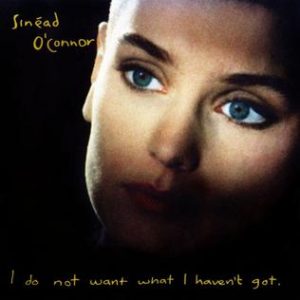 Sinéad O’Connor
Released 1990/03/20
I first got into Sinead O’Connor in the late ‘80s with her Lion and the Cobra album, which had a definite non-mainstream, art-rock, dance-y, new wave vibe. So the relatively straightforward, more musically conservative feel of I Do Not Want What I Haven’t Got disappointed me a little, at first. But after a few listens, I knew it was a keeper.
The more up-tempo, somewhat danceable “Emperor’s New Clothes” and “Jump in the River” develop along similar lines as her earlier work (although a little less self-consciously arty); “I am Stretched on Your Grave” sounds like a holy a capella remixed by a rap DJ; while the album’s more hushed numbers, like “Black Boys on Mopeds” and the title track, are haunting in ways merely hinted at on her debut.
Her cover of Prince’s “Nothing Compares 2U” is of course the most famous song on the album, and I do love it—but I’ve chosen other songs to represent the album for his playlist. It’s a rich, complex album—definitely the work of the same artist as her prior album, but more mature. Excellent.
The Breeders
Pod
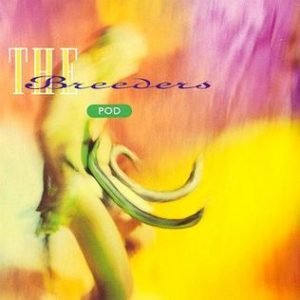 The Breeders
Released 1990/05/28
Way back in 1990, I remember being thoroughly disappointed by the latest Pixies release, Bossanova, which was not only completely lame sonically in comparison to their other albums, but—worse—seemed to be completely lacking in Kim Deal.
The Pixies were always at their best when Kim Deal was heavily involved, relieving Black Francis of lead vocal duties for a couple songs per album and providing great back-up vocals for the rest. When both Francis and Deal were singing, it was the perfect combination, perhaps the best 1-2 punch in music since Jagger and Richards together, with the lead singer’s solid vocal lines (Jagger, Francis) being enriched by a more piercing, discordant backdrop (Richards, Deal). (Not that Kim Deal couldn’t sing sweetly, of course, which she did on lead, but as a backup, her delivery often felt more dissonant and off-kilter.)
So I was pleasantly surprised when I discovered The Breeders’ debut album, Pod, which was so much better than Bossonova it was hard to believe any of the same people were involved. For the Breeders, Deal recruited another second fiddle, throwing Muses’ Tanya Donnelly, Brit Josephine Wiggs, and Slint drummer Britt Walford (credited as Shannon Doughton and appearing on stage in drag, to complete the all-“female” line-up).
The Breeders’ debut is terrific, as good as and possibly better than their excellent breakthrough Last Splash. (I go back and forth about which one I prefer.) Throughout, Deal brings the same combination of sweetness and grit ‘n’ grime she brought to the Pixies, the same propulsive, catchy bass lines (this time courtesy of Wiggs) and vocals, and makes ample use of the Pixies’ characteristic loud-soft-loud dynamics (which Nirvana later appropriated to greater financial success). At every turn, Deal’s sense of play is on full display, from the light and catchy “”Doe” and “Fortunately Gone” to the more rocking “Hellbound,” “Opened,” and “Lime House.”
“When I Was Painter” expertly uses those bass lines and dynamic shifts (and includes the amusing lines “Twenty hours later, I fill the room / With bad sex and bad TV”). And “Metal Man” takes the loud-soft-loud trick to task, teasing the listener with the potential aural assault—the quiet passages half-muttered by Wiggs and Deal in overlapping voices, a muted conversation in the background—and the big bang at the finale never arriving.
The whole album is just terrific. I love it just as much now as I did back then. I don’t love the Beatles cover as much as some do, but there are plenty of other great songs to choose from. I had a hell of a time picking three tracks to best represent this album—on another day I could easily have picked three entirely different tracks.
Donnelly would leave before the Breeders’ next album (perhaps realizing she was still second fiddle, this time to Kim Deal) to form her own band, Belly. More good music for us!
Sonic Youth
Goo
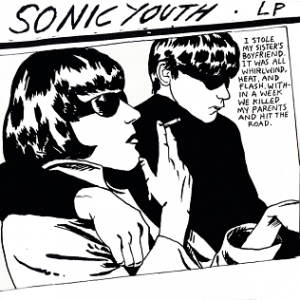 Sonic Youth
Released 1990/06/26
There’s always that combined sense of excitement and disappointment when a great underground band suddenly starts getting widespread attention among a much larger audience. It’s great to see a favorite band finally get the recognition they deserve. But there’s also the jealous fan’s selfishness at having so many people at what was once a small, private party.
I suppose the Sonic Youth party was still fairly small, though, even with Goo. A friend and I saw them live on the Goo tour, in a tiny venue in Houston, and I seem to remember easily getting within a few feet of the stage. (Ditto for the Pixies on their Doolittle tour, same venue.)
Regardless, Sonic Youth’s Goo was a worthy—if less great—follow-up to their breakthrough Daydream Nation, a step in the progression toward more rockish production and song length, which would culminate in their next album, Dirty.
On Goo, Kim Gordon really comes to the forefront, with easily the two best songs on the album, “Tunic” and “Kool Thing”—two of the best accessible songs of the band’s career, in fact—plus the amusing “My Friend Goo.” How cool was it that the best alt-rock band of its time (before we called it alt-rock) had three different lead singers, one of whom was female?
Elsewhere, Thurston Moore shines on the excellent album opener “Dirty Boots,” which slowly gathers steam toward a guitar-frenzy climax, before drifting off into tranquility—all in typical Sonic Youth fashion. Lee Ranaldo’s “Mote” is another highlight, as is Moore’s “Disappearer”; each features the kind of guitar chaos, grind, and droning haze that the band excelled at.
And even when Sonic Youth makes what for them might be considered a “pop” song, they subvert the rules. Case in point: listen to how they turn the bridge of “Tunic” into a near-minute of hazily echoing voices and suspended, shifting vacuum-cleaner guitar noise—only to snap back into the song as if nothing had happened. Most days, I wouldn’t trade that minute for the entirety of My Bloody Valentine’s output.
With Goo, Sonic Youth took a small step toward the mainstream, without compromising their identity, and the mainstream would soon reciprocate, taking an even bigger step in their direction.
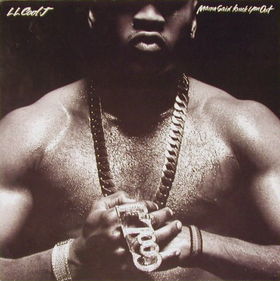
LL Cool J
Mama Said Knock You Out
 LL Cool J
Released 1990/09/14
I remember liking LL Cool J’s Mama Said Knock You Out around the time I picked it up (probably a year or so after its release, after seeing it in best-of-the-year lists, when my yearly buying and listening sprees would generally begin), and I was surprised to like it even more now.
I don’t remember listening to it very much at the time, in fact, maybe because one of my roommates back then couldn’t tolerate rap music. Which is too bad. Because Mama Said Knock You Out is hands-down one of the best mainstream rap albums of all time. Great beats, great raps, very solid, all the way through (a rarity in all genres, but even more so in rap).
It should say something that the most well-known songs from this album (“Around the Way Girl, “The Boomin’ System,” the title track), while quite good, would not find a place in the best half of the tracks of the album. That’s how strong the rest of this album is.
“Milky Cereal” rides a crisp, tasty groove and amuses endlessly with a wheat-field’s worth of innuendo; “Jingling Baby” is fresh, funky, and catchy as all get-out, the remix an improvement on the original; and the old-school rap “Cheesy Rat Blues” is a modern-day celebrity’s “Nobody Knows You When You’re Down and Out.”
LL’s popularity had waned with his last album, and he was speaking from experience about all the hangers on who ditched him when they felt he was no longer hip enough. But Mama Said Knock You Out was more than a return to form—LL Cool J established a new standard for what mainstream rap should sound like.
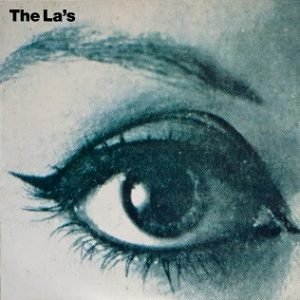
The La’s
The La’s
 The La’s
Released 1990/10/01
Every once in a while an album comes about by an artist that appears to have arrived on the scene fully formed, having completely absorbed and synthesized a wide range of rock and pop sensibilities into a perfect, complete, rich distillation of edgy new-wave pop-rock.
I’m thinking primarily of three albums here—the debut albums by the Strokes, the Knack, and here, the La’s. For some reason, each of these bands fizzled after one album; maybe they were great at summarizing the work of the past but less good at forging something new. (The best of them, the Strokes, did manage to decline a little more slowly than the other two.)
I had heard of the La’s back in the day but never listened to them, to my recollection. That’s okay, actually, because I like this kind of thing nowadays more than I would have then. My ears were enamored with Sister and Surfer Rosa and It Takes a Nation of Millions to Hold Us Back at the time, and this might have been a bit too straight-up power-pop for me. I’m not sure I would have appreciated it.
Each song here is a well-crafted, alt-power-pop gem—from the aching, melodic, minor hit “There She Goes” to the percussive, lurching “Way Out,” the jaunty trot of “Son of a Gun,” the sea-shanty sway of “Freedom Song,” and the power-chord splendor of “I Can’t Sleep.” The band charms throughout. Too bad the band only had one album—although I swear I can hear their influence on Oasis, especially every once in a while in the vocals. So they live on, in a way.
Here’s the 1990: The Year in Review playlist for you—three tracks per album.
The playlist is sequenced chronologically according to release date (with a few concessions to playability), with the exception of the Sonic Youth album which opens the playlist and the KLF album which should close it (not currently available in Spotify).
Enjoy!
Playlist Notes:
- I was not able to find the KLF’s Chill Out album on Spotify.
- Neil Young’s discography is currently unavailable in Spotify, including Ragged Glory (1990).
More 1990, The Year in Review
More Years in Review of the 1990s…
Cover Art Citations:
- Chill Out: By The cover art can be obtained from KLF Communications., Fair use, https://en.wikipedia.org/w/index.php?curid=984761
- I Do Not Want What I Haven’t Got: By allmusic.com, Fair use, https://en.wikipedia.org/w/index.php?curid=1254621
- Pod: By The cover art can be obtained from 4AD/Elektra/ 4AD., Fair use, https://en.wikipedia.org/w/index.php?curid=1329387
- Goo: By The cover art can be obtained from DGC., Fair use, https://en.wikipedia.org/w/index.php?curid=65058577
- Mama Said Knock You Out: By http://static.rateyourmusic.com/album_images/o8973.jpg, Fair use, https://en.wikipedia.org/w/index.php?curid=13390934
- The La’s: Fair use, https://en.wikipedia.org/w/index.php?curid=13410773

Wow. Sonic Youth and the Pixies in the same small club in more or less the same year. What a time to be alive. Nice playlist.