


I must admit that choosing a final 10 albums to complete my Top 30 often feels a little arbitrary. The whole list feels somewhat arbitrary, of course; but the sheer number of good-but-not-great albums in any given year is astounding.
Often there are several albums with three or four tracks I absolutely love, and several tracks that fail to inspire me in any way. How does an album like that measure up against an album that’s very good all the way through, but without any songs that genuinely possesses me? (Usually, I tend to take the uneven album with songs I love over the solid albums that are ultimately less memorable… but not always.)
Often, the inclusion on the back end of the Top 30 comes down to a few basic questions: Have I ranked this artist highly elsewhere? Do I have a good variety of musical styles on the list? Which albums are more memorable and distinctive, regardless of their quality throughout? And sometimes the picks are made on a bit of a whim. Needless to say, there are many worthy albums that haven’t made this list.
So without further ado, here are…
The Next 10 Albums,
for My Top 30 Albums of 1970
As always, you can jump to the playlist at the bottom of each post to listen while you read.
Within each tier (Top 6, Next 6, etc.), all albums are listed roughly chronologically (all release dates from Wikipedia, unless otherwise noted).
 John Phillips
 (John the Wolfking of L.A.)
 John Phillips
Released 1970/01/25
John Phillips moves on from his fellow Mamas and Papas on his first solo album, John, the Wolfking of L.A., for a fine set of country-ish songs performed by a crack crew of L.A. musicians.
Phillips’ charm draws you in irresistibly on the best tracks here, whether he’s describing romantic beachside shenanigans on the spritely “Down the Beach,” drinking a beer in the hazy heat by the slow-as-molasses “Mississippi” river, or bemoaning the junkie bums stealing his black Pearl drums.
When it comes to Phillips’ lyrics, there’s always something slightly edgy or counterculture beneath the surface. “Mississippi” finds Phillips sipping a beer and flirting with a drag queen. (She dresses herself up to look “good, like a lady”). The lyrics ooze hazy indeterminacy: “Down on the bayou, why, you never know just what you’re doin’… / Swamps all around make ya feel kinda funny, don’t they, honey?” Indeed.
Listen to the Mamas and the Papas.
Notable Critical Mentions:
- Acclaimed Music top albums of the ’70s, No. 622
Playlist Note: John Phillips (John the Wolfking of L.A.) appears to be unavailable on Spotify.
The Doors
Morrison Hotel
 The Doors
Released 1970/02/09
The Doors get their mojo back with the excellent Morrison Hotel, easily their best album since their 1967 debut. Career highlights include “Roadhouse Blues,” “Waiting for the Sun,” “Peace Frog,” and “Queen of the Highway.” Their resurgence would continue with 1971’s L.A. Woman.
Listen to more Doors [now updated!].
Notable Critical Mentions:
- Acclaimed Music top albums of the ’70s, No. 281
- 1001 Albums You Must Hear Before You Die (2005)
Rodriguez
Cold Fact
 Rodriguez
Released 1970/03
I vaguely remember hearing of the 2012 cult documentary Searching for Sugar Man about Sixto Rodriguez. Seems to me I had heard something about it and was curious, but never saw it and quickly forgot about it. But after stumbling across this album in my recent research and digging a little deeper, the name of the documentary rang a bell.
By the time I’d remembered the documentary, though, I had already fallen for this album. (I still haven’t taken the time to check out the film, and I might not. Sometimes I find a closer look at an artist actually leaves me a little disenchanted with them, to be honest.)
There are heavy sprinklings of Dylan here, in the rambling but thematically linked, often allegorical lyrics of songs like “Crucify Your Mind,” “Hate Street Dialogue,” and “This is Not a Song, It’s an Outburst: or, The Establishment Blues.” But Rodriguez—the sixth child of a Mexican immigrant father and Native American mother, growing up in inner city Detroit—brings a more distinctly class-based, anti-authoritarian, confrontational fire to the table. In his gentler moments—most of which come on his less impressive sophomore release, 1971’s Coming from Reality—he sounds a bit like Cat Stevens.
The story of Rodriguez, too, is one certainly worthy of a film: he recorded two unheralded albums in the U.S. before his label dissolved. Rodriguez then retired from the music business—only to discover decades later that his fame had slowly grown in Australia and especially in South Africa, where his views resonated deeply in the context with those living under apartheid. There, his albums had gone platinum (without him receiving royalties, it seems).
It’s a good story, and the quality of the music warrants the attention he has received. Check it out.
The Beatles
Let It Be
 The Beatles
Released 1970/05/08
Released about a month after their breakup was made official, Let it Be was the Beatles final proper studio album. It’s a classic, yes. But not one of their very best.
Sure, it has a handful of terrific songs: McCartney’s rhythmic, propulsive “Get Back” and the stirring title track, plus Lennon’s despairing “Across the Universe.” And I love Harrison’s “For You Blue,” with its springy beat and sunny melody.
But too many of the tracks here are of the type that would qualify as interesting filler on a typical Beatles album—something to add variety and perhaps keep you a little off-balance, like “Two of Us,” “Dig an Pony,” “I Me Mine,” or little snippets like “Maggie Mae” or “Dig It.” Mind you, I do like these tracks—it’s just that they don’t add up to a great album all on their own.
And even though I can see the significance of songs like the title track and “The Long and Winding Road” as comments on the band’s dissolution, I don’t really love them for it. (The version of “Winding Road” on Let It Be… Naked is better, stripping it of its treacle string arrangements.) I suppose if I’d lived through the spectacular arc of the Beatles’ career as an adult, I’d feel differently. (I’d just turned two when this album came out.)
Regardless, Let It Be is a good album, to be sure, but it falls short of the greatness the Beatles had achieved throughout their peak. And as a final farewell, it only occasionally feels like a swan song; more often, it feels a bit too much like a last gasp.
Notable Critical Mentions:
- Acclaimed Music top albums of the ’70s, No. 173
- Pitchfork: The 100 Best Albums of the 1970s, No. 28
- Rolling Stone: 500 Greatest Albums of All Time (2003), No. 86
- Paste: The 70 Best Albums of the 1970s, No. 11
Ike & Tina Turner
Come Together
 Ike & Tina Turner
Released 1970/05
Ike & Tina Turner released two albums in 1970, which are known to be among the best of their career, Come Together and Workin’ Together. I haven’t listened to everything they did, so I can’t confirm or deny. But both albums are very good, presenting a solid mix of originals and covers. Tina can really belt it out, and Ike and the band play a charged, funky R&B to back her up. The results are fiery and infectious. Great stuff.
I prefer Come Together to Workin’—both the originals and covers are better—but of course I would rather listen to my single-LP fusion of the two. Here it is:
Side A (the originals): “It Ain’t Right (Lovin’ to be Lovin’),” “Too Much Woman (For a Henpecked Man),” “Unlucky Creature,” “Young and Dumb,” “Doin’ It,” “Funkier Than A Mosquita’s Tweeter,” “Game Of Love,” “Workin’ Together.”
Side B (the covers): “Proud Mary,” “Honky Tonk Women,” “Evil Man,” “(As Long As I Can) Get You When I Want You,” “Come Together,” “I Want to Take you Higher.”
Delaney & Bonnie
To Bonnie from Delaney
 Delaney & Bonnie
Released 1970/09
Delaney and Bonnie Bramlett had already impressed both Eric Clapton (who essentially abandoned Blind Faith to tour with their band, believing them to be the superior group) and George Harrison (whom Delaney reportedly taught the slide guitar for which he later became known) when they released two albums in 1970, the fiery blues-rock of On Tour with Eric Clapton and the soulful folk-blues studio album To Bonnie from Delaney. Both are worth many listens, as is their excellent 1971 live-in-the-studio release Motel Shot. On those three albums, they masterfully blend soul, R&B, gospel, blues, folk, and rock into a glorious crystallization of rock and roll bliss.
Most critics seem to prefer the live album, but I actually prefer To Bonnie from Delaney. On Tour boasts a more powerful sound, but To Bonnie gives them space to let their personalities and sense of humor shine more clearly through.
I had honestly never heard of Delaney & Bonnie before the retrospective listening project that has since become this website. None of their songs rang a bell when I began listening. But their imprint is felt on such keystone classic rock albums All Things Must Pass and Layla and Other Assorted Love Songs, and in the careers of Leon Russell and Duane and Gregg Allman, all of whom played in the Delaney and Bonnie and Friends band. Check them out. You’ll be glad you did.
Santana
Abraxas
 Santana
Released 1970/09
Santana’s Abraxas is considered an absolute masterwork of Latin jazz-infused classic rock. It’s pretty hard not to like it, really. Put it on. It draws you in, it entices and grooves. I should probably have rated it higher.
But it all seems very mainstream to me, very tidy and tight for something supposedly so adventurous—although I guess maybe it didn’t feel so tidy back then. Nowadays, it doesn’t seem very cutting edge to like Santana. It’s good, but it feels very… clean.
Regardless, there is plenty to like here, from the cover of Fleetwood Mac’s “Black Magic Woman” to the infectiously grooving “Oye Como Va” and the rocking organ grind of “Hope You’re Feeling Better,” packed with nearly as much aggression as King Crimson’s “21st Century Schizoid Man.” Plenty of rumbling congos, shimmering electric organ, and of course, Carlos Santana’s masterful electric guitar work all push the music to glorious heights.
Abraxas ebbs and flows and pulls you along with it in a rollicking swirl of energy. Very good stuff. It goes down easy, but that’s not a bad thing.
Notable Critical Mentions:
- Acclaimed Music top albums of the ’70s, No. 71
- 1001 Albums You Must Hear Before You Die (2005)
- Rolling Stone: 500 Greatest Albums of All Time (2003), No. 205
 As an aside, I must confess I love the album cover here. Pretty damned cool, like a surreal, psychedelic, African-themed collage—is it the same artist that did Miles Davis’ Bitches Brew? [looks it up…] Yes it is.
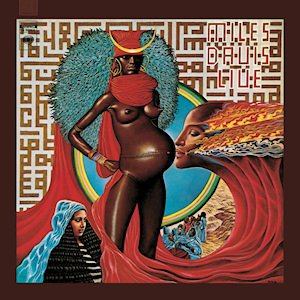
Mati Klarwein, a white-as-can-be French artist (of German origin—his family fled Nazi Germany when he was young) who seemed (at least for a time) to favor dark-skinned African woman as subjects, often with shaved heads. Curious.
I do like the paintings—very intriguing. I definitely see a Dali-esque vibe. Some beautifully cosmic stuff.  He did the cover for Live Evil as well—a very intriguing image—and also covers for such jazz artists as Jackie McLean, Eric Dolphy, and Herbie Hancock, plus rock artists like Jimi Hendrix, Jerry Garcia, and Buddy Miles.
 Note: This reminds me, for those of you expecting to see Miles Davis’ Bitches Brew somewhere in my top albums of 1970, I keep the jazz separate. Eventually, I’ll have yearly playlists for jazz, as well. (It will be quite a while.) For now, I have some Artist Spotlights, including one for Miles Davis, which has some tracks from the brilliant jazz-rock fusion album Bitches Brew.
Van Morrison
His Band and The Street Choir
 Van Morrison
Released 1970/11/15
His Band and The Street Choir, Van Morrison’s second album of 1970, finds him straddling the two poles of his sound—from the more grounded soulful pop of “Domino” to more pleasantly adrift tracks like “Virgo Clowns” and “Crazy Face.” I’d say several of the tracks have a jazzier feel than on most of his other albums.
Overshadowed by Moondance, His Band and the Street Choir is nevertheless one of the best albums of Morrison’s career. (If I hadn’t already ranked Moondance so highly, I would no doubt have placed this album higher—which shows I’m guilty of the same neglect as all the others who’ve overlooked it.)
Notable Critical Mentions:
- Acclaimed Music top albums of the ’70s, No. 558
Stephen Stills
Stephen Stills
 Stephen Stills
Released 1970/11/16
I had no idea Stephen Stills had this album in him.
Within a year of the dissolution of Crosby, Stills, Nash, and Young, each of the four band members would release a landmark album. Neil Young’s After the Gold Rush is the best of the bunch, but Stills’ self-titled release is more than worthy of note.
Although the album has a bit of the feel of a hodgepodge, patched-together effort (which it apparently was), Stills delivers a varied selection of excellent songs here. The backing singers on the terrific “Church (Part of Someone)” and “Sit Yourself Down” give them the inspirational feeling of a church choir. Both songs are at once easily identifiable as Stills’ work, yet sound unlike anything he’s done before.
The fierce acoustic blues guitar picking in “Black Queen” absolutely rips, and Stills’ earthy singing matches the intensity of the playing. Breathtaking. Some sort of electric sitar, plus jazz flute and saxophone, compete with R&B organ and a full horn section on “Cherokee”–I’m not sure if it all works, entirely, but it at least almost does, and pretty impressively, too.
One track I find rather unimpressive, relative to the best of the album, is the big hit, “Love the One You’re With.” The lyrics are actually pretty great (if not particularly moral)—some advice on finding love nearby when your true love is far away—but the music seems pretty run-of-the-mill CSN to me. No new ground broken. But I guess that’s why it was the hit. It’s a good song, but not one of the most distinctive here.
Notable Critical Mentions:
- Acclaimed Music top albums of the ’70s, No. 495
- 1001 Albums You Must Hear Before You Die (2005)
- NME Writers All-Time 100 (1974), No. 70
Playlist Note: Stephen Stills appears to be unavailable on Spotify.
Karlheinz Stockhausen
Stimmung
 Karlheinz Stockhausen
Written 1968; released 1970 (Source, Discogs.com)
Don’t ask me to start explaining such things as polyphony, harmonics, and overtones. But I can tell you this: Avant-garde composer Karlheinz Stockhausen’s Stimmung is some weird-ass shit.
Written for six unaccompanied voices, it’s a piece that features eerie, vacillating drones overlapping in unusual ways, non-verbal vocal rhythms, and other vocal “melodies” that dance over the swirling and pulsing haze beneath. If listening to Stimmung makes you slightly seasick, understand that this may be a normal response.
Certainly, this is not music for anyone with remotely conventional tastes. I know it’s great every time my wife shoots me a look that says, “What is this awful stuff that pretends to be music?” while I’m playing it. Score!
The original 1970 release is by Collegium Vocale Köln (with whom Stockhausen wrote the piece in mind), but the version I am familiar with is by Singcircle, directed by Gregory Rose, released in the ‘80s. Spotify has two versions available, one by Paul Hillier and the Theatre of Voices, the other by Electric Phoenix.
Here’s the 1970: The Year in Review playlist for you—three tracks per album.
I’ll be building the playlist as I go, adding to it as I complete different tiers of commentary. By the time I finish all Year in Review posts for 1970, the playlist will be complete!
Enjoy!
Playlist Notes:
- John Phillips’ album John Phillips (John, the Wolf King of L.A.) does not appear to be available on Spotify. My selections are “Down the Beach,” “Mississippi,” and “Drum.”
- Stephen Stills’ self-titled debut album does not appear to be available on Spotify. My selections are “Sit Yourself Down,” “Church (A Part of Someone),” and “Black Queen.” [Update: The album now appears to be available. Playlists updated.]
More 1970, The Year in Review
More Years in Review of the 1970s…
Art Citations:
- John Phillips (John the Wolfking of L.A.): By The cover art can be obtained from Dunhill., Fair use, https://en.wikipedia.org/w/index.php?curid=24451823
- Morrison Hotel: By Published in ad on page 27 of February 20, 1978 Billboard magazine., Fair use, https://en.wikipedia.org/w/index.php?curid=20132925
- Cold Fact: By The cover art can be obtained from SussexBlue Goose/RCAA&M Records., Fair use, https://en.wikipedia.org/w/index.php?curid=7209846
- Let It Be: By Resampled from digital copy included on The Beatles USB Box Set, Fair use, https://en.wikipedia.org/w/index.php?curid=142101
- Come Together: By Liberty Records – https://www.the-world-of-tina.com/come-together—album.html, Fair use, https://en.wikipedia.org/w/index.php?curid=63412897
- To Bonnie from Delaney: By The cover art can be obtained from Atco., Fair use, https://en.wikipedia.org/w/index.php?curid=14718856
- Abraxas: By May be found at the following website: https://www.amazon.com/exec/obidos/tg/detail/-/B0000062FL, Fair use, https://en.wikipedia.org/w/index.php?curid=200972
- His Band and The Street Choir: By May be found at the following website: https://www.amazon.co.uk/His-Band-Street-Choir-Morrison/dp/B000002KBD/ref=sr_1_1?ie=UTF8&s=music&qid=1279747623&sr=8-1, Fair use, https://en.wikipedia.org/w/index.php?curid=2325572
- Stephen Stills: By https://www.amazon.com, Fair use, https://en.wikipedia.org/w/index.php?curid=1845419
- Stimmung: Source, Discogs.com
- Bitches Brew (gatefold): By cover art for the album Bitches Brew by the artist Miles Davis. The cover art copyright is believed to belong to the label, Columbia Records, or the graphic artist, Mati Klarwein, Fair use, https://en.wikipedia.org/w/index.php?curid=2811190
- Live-Evil: By The cover art can be obtained from Columbia., Fair use, https://en.wikipedia.org/w/index.php?curid=3537129
- Sextant: By Amazon.com, Fair use, https://en.wikipedia.org/w/index.php?curid=18951343
- Hooteroll?: By May be found at the following website: https://www.music-bazaar.com/world-music/album/553189/Hooteroll/, Fair use, https://en.wikipedia.org/w/index.php?curid=12037778

Stephen Stills is one of the more underrated artists of his era. As far as triple threats go, singer/guitarist/songwriter, he has a breadth of talent that few can match. While I wouldn’t put him at the top of the lists for those individual categories, he has an overall talent greater than some of his peers who were/are household names.